On November 21st, 1883 the “Erie Belle” was destroyed in a boiler explosion two miles south of Kincardine.
She was a wrecking tug owned by a Windsor firm. Previously “Erie Belle” had been a passenger steamer, first on the Atlantic coast and later on Lake Erie. She was 125 feet long and 25 feet wide.
The tug had been sent from Windsor to Kincardine to pull off the sailing vessel “J.N. Carter”, loaded with square timber and stuck fast on a sandy point south of Kincardine.
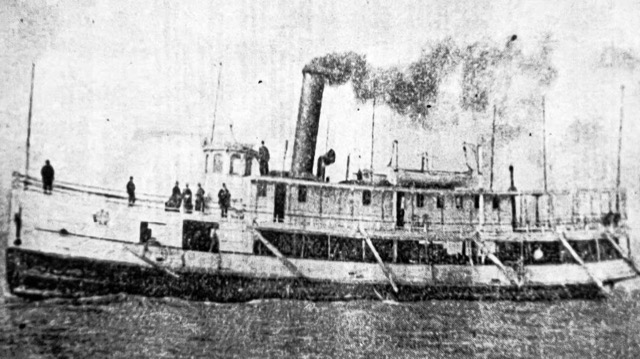
It was a typical November day, with a cold wind and blowing snow to make more miserable the work of the sailors. Capt. John E. Tobin was directing operations, while below Bill Osgoode, chief engineer, was watching the steam.
Government inspectors allowed no more than 65 pounds of steam for the “Erie Belle” and under proper circumstances the surplus would have blown off. But Bill was conservative with his steam and had rearranged the boiler so that it would take 100 pounds of steam without blowing off. At least he thought it would.
But on Nov. 21, 1883 the boiler couldn’t take it and with an explosion which was heard around for miles, blew the tug to pieces and sent the members of the crew hurtling through space, to leave some dead and some maimed on the waters of the lake.
The engineer, his second, John Smith and William Sayles, the coloured fireman, were killed by the blast, for they were working in the engine room.
As debris fell about him, the captain of the ship floated helpless, his arms paralyzed, and only quick and gallant action by the wheelsman, Frank Conroy, saved the captain’s life. Swimming away from the piece of timber to which he had been clinging, the wheelsman placed his chief on it and started swimming to shore.
In the meantime the volunteer boat crew rushed from Kincardine to the scene of the disaster, where their life saving boat was already in use by the “Carter”, and brought to safety the crew of the ship which was now a floating mass of shattered timbers. Four crewmen died, while eight were blown overboard and rescued.
How did James Gardiner, a local man, come to be aboard the tug? That is simple. Henry Pocock, a young man of 18 and a member of the tug’s crew, had permission from the captain to allow Gardiner on board. When the explosion took place Pocock clambered out a porthole, dragging and pulling Gardiner behind him. Gardiner was injured from the explosion, becoming a recluse and living alone for many years in a shack in the bush north of Inverhuron. George Brown, coloured deckhand, escaped death in the disaster only to be drowned in 1910 when he fell from a pier at Windsor.
The body of the chief engineer was claimed by his brother and taken to Lorain, Ohio, but the fireman, Sayles, was buried in Kincardine cemetery, while the body of the cook was taken to Windsor. William Johnston, another fireman, lived two years after the disaster but was mentally unbalanced and died in an institution in London.
John E. Tobin, captain of the “Erie Belle”, lived till 1917 and for many years was well known on the lakes as an able sailor. His brother, Billy Tobin, who was a mate on the ship, died in 1893 and Conroy, who saved the captain’s life, passed away in 1897 at Prescott. Don Finlayson, another member of the crew, was blinded as a result of the mishap. He passed away at Windsor.
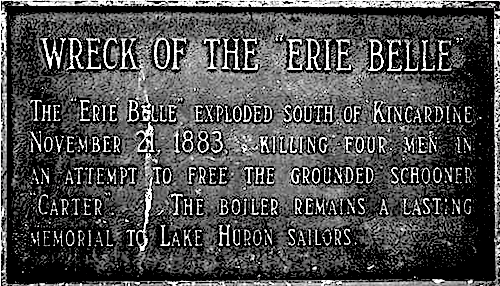
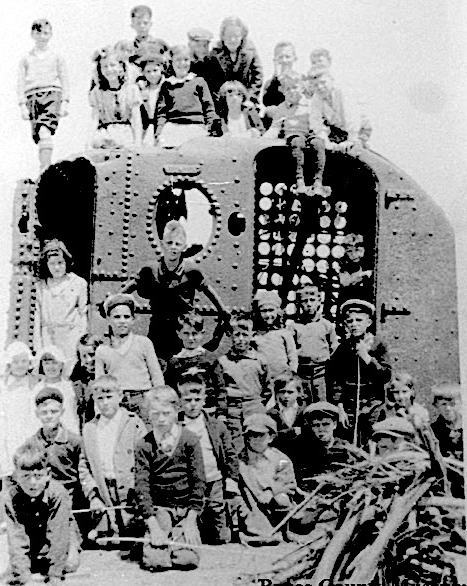
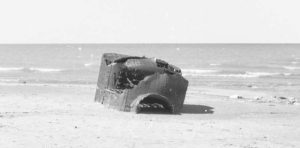 The tug’s boiler lay on the lake bottom until 1930 when Frank McPherson Sr. dragged it up on the beach, intending to bring it to Kincardine and set it up in the town park as a memorial. Mr. McPherson could get no support for his idea so it remained on the beach.
In 1933 Henry Pocock, the sole remaining survivor, visited Kincardine and suggested that the tug’s boiler be erected as a monument to the bravery of the sailors who lived and died in a life of service on the Great Lakes. Nothing was done at that time.
In 1965 Ted Rowcliffe, a keen enthusiast in ship lore and skin diving, and a member of the Bruce County Historical Society (BCHS), renewed interest in preserving the remains of the boiler of the “Erie Belle” from souvenir hunters and scrap dealers. A park known as Boiler Beach Park was established in 1965, with the old boiler being preserved as a monument for those who wish to reminisce about the early schooner days along the shoreline of Bruce County.
* * *
That was the story in 1965 when historian Bruce Krug was writing in the BCHS newsletter. 61 years later there is a new development.
The Kincardine News reported July 8, 2026 that volunteers from the Ontario Marine Heritage Committee (OMHC) have wrapped up a licensed archaeological survey of the Erie Belle wreck site. Divers did not retrieve any artifacts, only recorded and photographed the scattered parts of the ship—there is no actual wreck lying on the lake bottom. OMHC will also take detailed measurements of the ship’s boiler lying on Boiler Beach.
* * *
On Wednesday, August 5th at 7 p.m. join Montreal film maker Deke Richards as he debuts “Reflections of Rebellion”, the new English version of his one-hour documentary “Land of a Thousand Sorrows Revisited.” Learn about the events of the 1838 Upper Canadian Rebellion and the subsequent exile of 93 convicted state prisoners to Van Diemen’s Land. A Q&A period will follow, with Mr. Richards and rebellion expert Dr. John Carter.
Admission is free but seating is limited, REGISTER HERE This BCHS event is hosted by the Bruce County Museum & Cultural Centre.
* * *
Local authors will speak at the annual Authors Night on Monday, August 10th at 7 p.m. in the Bruce County Museum Theatre, Southampton. There will be talks by Allen Smutylo (“Gold of Another Kind: The Lost Legacy of Georgian Bay”); Diane Allengame (“Brilliant Obsession: Building the Imperial Tower Lighthouses”); and the editors of the new Historical Society book “Furrows of Bruce County: A harvest of stories from the farm”.
This joint event by BCHS and the Bruce County Genealogical Society is free and features a wine and cheese reception and a cash bar. Seating is limited – REGISTER HERE
———————————————————————
submitted by Robin Hilborn
for the Bruce County Historical Society