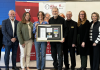
The remarkable story of Kincardine native Sir Alexander Mackenzie — who built an electrical utility empire that transformed Brazil — was the subject of this year’s keynote at the Bruce County Historical Society annual meeting on October 24th.
Carleton University journalism professor and Glammis native Allan Thompson used the keynote to share his research into Mackenzie, based on visits to archives on three continents.
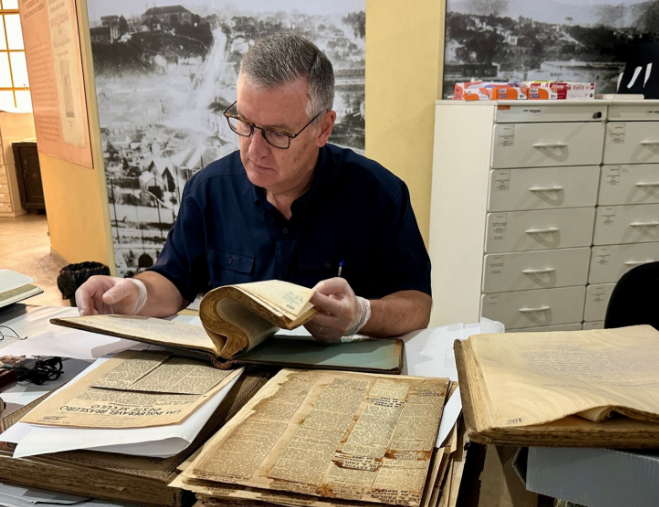
“This is the story of one of Canada’s most successful but least remembered business leaders, a remarkable yet mysterious Canadian who has been denied a place in our imagination,” Thompson said at the opening of his address. “I call him Canada’s lost tycoon.”
The keynote was delivered in the Kincardine Legion Hall, which coincidentally is built around the Lake Huron waterfront mansion that the legendary Mackenzie used as a summer home from 1912 until his death in 1943.
Thompson used a slideshow with historic photos, archival documents and even home movies shot by Mackenzie himself in the 1920s and 1930s to share the story of a man who became a transformative figure in Brazil as the long-serving head of the Brazilian Traction, Light and Power Company, commonly known as The Light.
Despite building South America’s largest utility and Canada’s largest overseas company, Mackenzie remains largely forgotten, a point that Thompson underlined.
“I have always been struck that in the very building where he lived and died, there’s no evidence of his having been here. He’s been forgotten,” Thompson said.
The gathering was attended by several of Mackenzie’s living descendants, including his grand-niece Ann Laubstein of Ottawa (the granddaughter of Mackenzie’s sister Emma) and grand-nephew Donald Mackenzie (the grandson of Mackenzie’s brother Kenneth).
Born in Kincardine in 1860 to a Scottish pioneer family of eleven children, Mackenzie showed early intellectual promise. At just 17 years of age, he graduated high school and was recruited by prominent Liberal politician Edward Blake to article with the Blake law firm in Toronto.
Mackenzie’s career trajectory changed permanently in June 1899 when he was dispatched by the law firm on what was intended to be a six-month legal assignment to Brazil. Dubbed the “donkey deal,” the venture aimed to build Brazil’s first hydroelectric dams and establish electric streetcars in São Paulo, where public transit relied entirely on mule-drawn trams. Mackenzie secured political concessions, navigated the new republic’s complex political bureaucracy, and launched the city’s first electric streetcars by May 1900, followed shortly by the country’s first major hydroelectric dam.
Thompson detailed how, after learning fluent Portuguese, Mackenzie became the most influential foreigner in Latin America as the utility empire expanded from Sao Paulo to Rio de Janeiro and came to encompass the electrical grid, streetcar networks, telephone exchange, gas utility and railways.
“This would be like Bell Canada, Via Rail, the Toronto Transit Commission, Consumers Gas, all in one company, one enterprise,” Thompson said. “That’s a monopoly 100 per cent owned by investors in Canada. So, with the task of defending that monopoly, Mackenzie spent much of his time in court fending off the owners of the other corporate interests that he was competing with.
Beyond managing corporate strategy, Mackenzie played a crucial role in steering Brazil to join the Allied forces during the First World War. In recognition of his global business achievements and diplomatic influence, King George V knighted him in 1919, making Mackenzie the only Bruce County native ever to receive a knighthood.
Mackenzie maintained deep ties to his hometown. Travelling by steamship, he returned every summer to his Kincardine mansion, doted on his mother and was also extraordinarily generous with his siblings, in many cases building them homes and helping with living costs. He also maintained grand residences in Berkshire in the United Kingdom and retired to a 34-room villa in Florence after stepping down from the Brazil enterprise in 1928 due to ill health.
Brazilian Traction eventually evolved into the Canadian colossus Brascan and later into Brookfield, now a trillion-dollar global asset management corporation.
Near the end of his address, Thompson reflected on Mackenzie’s remarkable journey from a pioneer blacksmith’s home to international prominence, describing him as “Canada’s lost tycoon” whose extraordinary story deserves to be reclaimed.
And with a large portrait of Mackenzie on the screen behind him, Thompson described a sense of getting to know the man.
“I’m left with the piercing gaze of this man, Alexander Mackenzie. I sometimes felt sitting in those archives with his picture on the wall, his handwritten documents in front of me, I did feel like I was spending time with him, getting to know him a bit better.
“He stares out at me from all those pictures, and I just come away from it realizing what a remarkable person came from our town, someone who did so much in the world and transformed a country, Brazil.”
The historical society’s newsletter editor and noted local historian, Robin Hilborn, thanked Thompson for his address.
“I would like to thank Allan for bringing us information on not only our county — which we’re always very proud of — but also the residents of the county, and ones that we probably never realized their contribution to society and to the economic occurrences in the world.”
A Story of Sir Mackenzie was also published in September, 2026 by Robin Hilborn
for Saugeen Times and Kincardine Times